GTM strategy is founder’s compass for early-stage growth
Updated, February 15th 2026
Early-stage founders are under immense pressure to grow, sometimes leading to "just sell" without a super clear plan. Go-to-Market (GTM) strategy is the antidote to this. But it shouldn't be a static, 50-page document that gathers dust. Think of it instead as a living guide that provides direction, focus, and a clear path to follow. It helps you make disciplined decisions about where to invest your most precious resources: time, money, and energy.
This blog post distils the GTM strategy into four essential, actionable pillars.
Pillar 1: Master your ICP
Ignore the ‘sexy’ TAM and get obsessed with your ICP.
The Total Addressable Market (TAM) is a substantial and impressive number that looks great in a pitch deck; however, for an early-stage startup, it's a false idol. The real key to initial traction is a hyper-specific Ideal Customer Profile (ICP), a laser-focused description of the ideal customer for your solution at this moment. This means going beyond industry to specify company size, revenue, geography, and even the specific tech stack they use.
Focusing on a narrow ICP is a strategic lever. It allows you to test hypotheses and iterate on your product more quickly. It helps you identify and dominate a single, effective customer acquisition channel before spreading yourself too thin. Most importantly, it's the foundation for building a sustainable, repeatable sales process that can scale as you grow.
👉 Read also:
Growth Diagnostic & GTM Strategy.: Assess your GTM and accelerate your growth
How to build an Ideal Customer Profile with AI (and AI agents)
Competitor analysis guide for GTM teams
Why B2B Marketing must own revenue, not just leads
SEO & GEO: The very latest shifts you need to know
AI brand visibility: optimise your brand for LLMs and AI search
Find your innovators and early adopters.
At the beginning, only two types of customers will be willing to take a risk on your unproven product: Innovators and Early Adopters. They are your entry point into the market.
An "Innovator" is motivated by being on the cutting edge. They want to be part of a community, feel like they are helping build the future of the industry, and are invaluable for providing candid feedback. An "Early Adopter," by contrast, wants to be the first to use a polished solution. Their motivation is tied to being seen as innovative and gaining a competitive advantage.
“Focus on your ICP to get a foothold and give you the resources/traction necessary to take on more of your TAM later.”
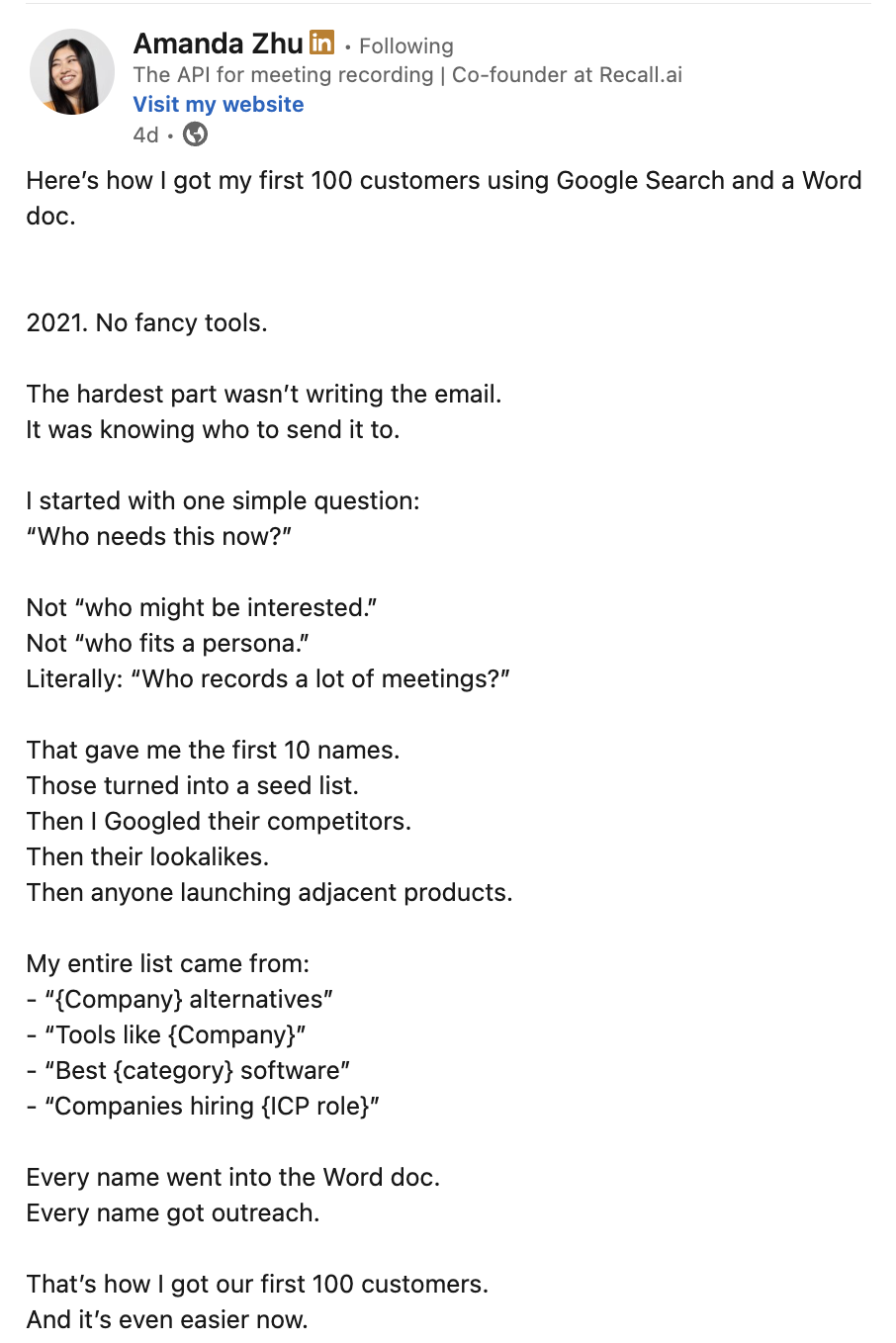
Co-founder of Recall.ai, Amanda Zhu, describes her first ICP strategy. Recall.ai closed 38M USD series B funding in September.
Pillar 2: Your story is your strategy: The founder narrative
Once you have a precise ICP, your next strategic move is to craft a narrative that resonates deeply with them. For an early-stage startup, your story is not a "nice-to-have" marketing asset; it's a critical piece of your strategy. Stories are how humans connect, and a compelling founder narrative makes your business memorable and builds trust. It explains why you started the company, making it easier for your ICP to connect with your product on a human level.
A well-told founder story demonstrates why your solution is the only one truly equipped to solve the problem your ICP faces. It’s the raw material for your messaging, your sales pitches, and your brand.
Frame the problem before you pitch the solution.
The most effective founder stories follow a distinct narrative arc. They don't start with the solution; they start with the problem. The story should clearly articulate the challenge you faced, your personal experience with that pain, the market trends that showed you weren't alone, why current solutions failed you, and the critical insight you had about what the problem truly needed. This transforms your story from an anecdote into an investment thesis.
“Use your founder story to frame the problem in the buyer’s mind.”
Validate your value with real conversations.
A great story is useless if it doesn't resonate with your target audience. You must test your narrative and value proposition through direct conversations with your ICP. These initial customer calls are not for selling; they are for understanding and validation. Selling too early can damage your credibility and close the door on valuable feedback. Remember, 42% of startups fail because they don't establish a genuine market need.
Pillar 3: Turn strategy into a system
A powerful story and a clear ICP are the fuel, but you need an engine to turn them into consistent growth. A GTM strategy requires a system to bring it to life.
Establish a routine to stay on track.
To operationalise your GTM plan, you need mandatory routines and check-ins to keep everyone aligned and accountable. Roadblocks will crop up, and a structured meeting cadence ensures they are identified and resolved quickly.
Kick-off session: A meeting with all stakeholders to align on the GTM plan, targets, timelines, and responsibilities.
Weekly GTM session: A regular check-in for team leads to provide status updates, share responsibility for progress, and call out any roadblocks.
Retrospective review: A one-off session after a launch or major initiative to gather feedback from the team and ensure continuous improvement.
What gets measured gets managed.
A strategy is only as good as the metrics used to measure it. Tracking the right GTM metrics provides quantifiable insights into your performance and allows you to make data-driven decisions instead of relying on gut feelings.
1. Customer Acquisition Cost (CAC): The total cost to acquire a new customer.
2. Customer Lifetime Value (CLTV): The total revenue a customer is expected to generate over their lifetime.
3. Sales Cycle Length: The average time it takes to turn a lead into a paying customer.
4. Conversion Rate: The percentage of prospects that become customers.
5. Churn Rate: The percentage of customers who stop using your product in a given period.
Pillar 4: Enable your champions
The final pillar leverages your system to empower customers to become internal champions for your solution. In B2B sales, you aren't just selling to one person; you're selling to an organisation. Your goal is to arm your key contact with an undeniable business case they can use to sell your product internally to decision-makers and budget holders.
Does your business case answer the TIM question?
Every great business case must clearly and simply articulate how the prospect gets Time, Image, and Money from your solution. This is the TIM framework, and it's the key to unlocking budget from sceptical stakeholders by translating features into business outcomes.
Time: How much time does your solution save the prospect?
Image: How your solution improves or defends the prospect's professional image.
Money: How much money your solution generates or saves.
The critical insight here is that once you have a TIM-based business case, you can more easily connect your pricing into the conversation as an explanation of value, not an expense to be justified. This bridges the gap between the value proposition and closing the deal.
“Selling is about making your customer’s life easier. Show them how you’re there to help.”
GTM strategy is your compass for growth
A powerful Go-to-Market strategy is a journey, not a destination. It begins with the sharp focus of an ICP, which allows you to craft a resonant Narrative. That story is then scaled through a disciplined System, empowering the Champions who will ultimately drive your growth. These four pillars work together to turn chaotic effort into predictable revenue.
Your GTM strategy isn't a static document; it's the operating system for your growth. Which pillar will you reinforce this week?
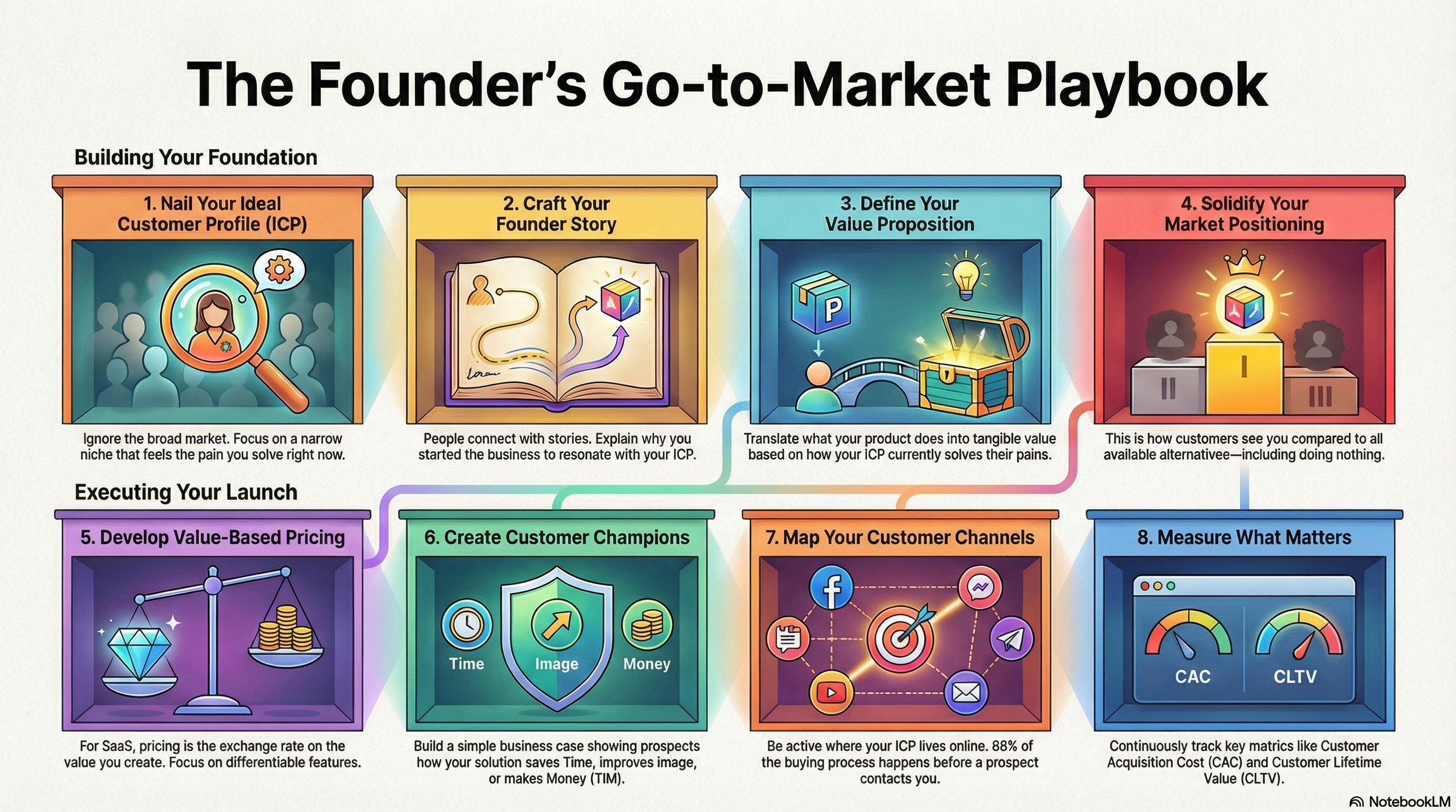
I created an Advent calendar-style GTM playbook for Founders with Notebook LM.